

Welcome to reThink Your Perspective’s blog. Helping you to unlock your potential, empower your mindset, create productive habits, and boost your motivation. Today’s topic is the Get Done List.
You can listen to this blog as a Podcast HERE.
To Do Or Not To Do? How About Get Done Instead!
We all traditionally use to do lists, or things to do today pads to keep our daily lives organised. But you can improve a to do list! You can change it from a list of orders to a list of motivation. You do this by using a different approach. A Get Done List. This technique will turn your ordinary to-do list into something much more powerful that will boost your motivation and get you closer to your success.
The Get Done List layout is three columns entitled Get Done, Doing, Got Done. I first covered this strategy in my Planituding approach, and more recently included it in my Time Mastery course. Time Mastery takes this productivity technique to the next level by showing you more techniques to help you stay on task and focused.
A get done list is much more effective for one simple reason. It creates a visual Got Done list. A visible list of things you have achieved to date, be it today or over the past month or years. These got dones give you a boost of pride and a sense of achievement on days when you feel like you aren’t being very productive.
So how does it work? Let us take a look.
Setting Up Your Get Done List
We are all individual, there is no one size fits all for anything. Get done lists are the same. You must find the set up that works for you, based on how you work. But the basic need is three columns.
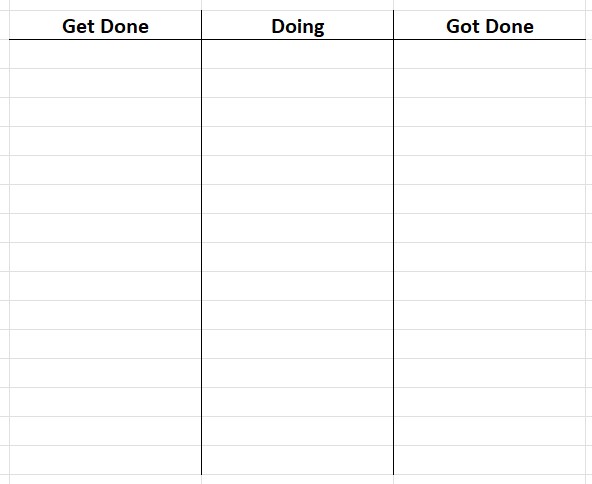
The first entitled “Get Done”.
The second is “Doing”.
And the third is “Got done”.
The only other stipulation is that you can physically move each item from one column to another. You should only be writing your get dones once, and then have the ability to move them around.
Some suggestions of how to set up your list include:
- Using a spreadsheet (you type the get dones and then can drag each cell around)
- Using a magnetic whiteboard (you write the get dones on magnet backed things. Be they laminated bits of paper, or small magnetic whiteboards)
- Using a board and post stick / post it notes or paper with blu-tak or drawing pins (cork boards, white boards, spare area of a wall… But the notes then move around)
Ensure your columns survive as you move things around! And also ensure that there is space for all the got dones you are going to achieve!
For your list to start, you simply start writing out the things you need to do. But for that I have come across a way to do it that is worth every second of reading the next section!
The $25’000 Idea
I heard this story from my mentor Bob Proctor, who was told it from his mentor Earl Nightingale. It is all about the president of a steel company who granted an interview to an efficiency expert named Ivy Lee. The steel company knew what they needed to do, but the president was struggling to manage it as well as he knew how. He needed more doing rather than more knowing. He needed better ways of getting things done, and offered to pay anything in reason that the expert asked.
The expert said he had an idea that would increase his efficiency by at least 50%, and the president could pay him whatever he thought it was worth after using the approach for as long as he liked.
The strategy is as follows:
- On a blank piece of paper, write down the six most important things you have to do tomorrow. Do this every evening.
- Now number them in the order of their importance to you / the company / business.
- Then, first thing tomorrow morning, look at item number one. Don’t look at the others, just number one, and start working on it. And, if you can, stay with it until it’s completed.
- Then take item number two the same way; then number three and so on until you have to quit for the day.
He also told the president not to worry if he only finished one or two, he was working on the most important ones; the others could wait. He said:
“If you can’t finish them all by this method, you could not have finished them with any other method.”
The $25’000 was what the president sent to Ivy Lee in payment for the idea. He said it was the most profitable thing he had learned in his life. It was also later said that this strategy was responsible for turning that then little known company, into one of the biggest independent steel producers in the world in just 5 years.
Now let us relate this to your get done list.
Using Your Get Done List
If you prefer to watch a video of how Get Done lists work, watch this:
Each evening, start by writing down all the things you need / want to get done tomorrow. Then prioritise these activities and put them in the Get Done column in the order of priority. When you get up the next day, start with number one and move it to the Doing column. Work on it until it is complete, or as complete as you can get it. Once complete, move it to the Got Done column.
Then, and only then, do you give attention to the next activity on the list. Move that to Doing and get on with it. Pay no attention to anything else on your list! Focus on one activity at a time. Try not to have too many things in the Doing column at any one time.
Focusing on one at a time allows you to complete that task with your full attention and engagement. This means that it will get done quicker, and to a better standard than if you are flitting between activities or getting distracted.
What Happens If I Get Distracted, Or Can’t Focus?
We are human and we live in a world of distractions! There are ways to minimise these; hiding your phone / silencing notifications. Putting on noise cancelling headphones with wordless music that helps you focus. Choosing a suitable, quiet place to work. Turning off notifications on your computer… But we all get distracted sometimes!
Know that it happens and is perfectly natural.
You simply have to refocus when you notice your mind has wondered off. Don’t give yourself a hard time about it! Just notice your mind has wandered off, and either bring it straight back onto the task, or step away for a moment to refresh.
It is good advice to take a short 5-minute break every 25 minutes whilst working. Getting a drink, using the bathroom, a quick walk, anything that helps to refresh you. Then you get back to the task you were on and keep going! More examples of techniques to stay productive are covered in my Time Mastery course.
How Many Things Do I Put On My Get Done List?
As you use this approach over time, you will learn how many Get Dones you are personally capable of achieving each day. Based on then activities you need to do. It can be very tempting to put loads of things on the list and then get demoralised when you don’t get many done…
This is the to do list approach!
To achieve the best of both worlds, have two Get Done lists. A master one which has everything you need to get done over the foreseeable future, and a daily one. Each evening, look at your master list and then choose the highest priority ones to put on your daily list for tomorrow. Tomorrow, you ignore the master list, it is still there, nothing will be forgotten from it, and just work from the daily one.
If you get everything done on your daily list, because you were more effective than you thought you would be, then you have your master list from which you can choose another activity from. Or, you get to do your pre-planned reward for getting everything done! Something that is just for you, that is your pat on the back. This can be a form of motivation to help you stay focused on the things you need to get done.
As I said, the longer you use this approach, the easier it will become to know how many things to put on your daily get done list to remain productive but equally not get demoralised.
Your list will be longer or shorter than others, and that is OK. We all have different commitments, amounts of time to dedicate to things, rates of work. That is what makes us individual. You work on your own list, at your own pace. Do not compare your productivity to anyone else but yourself.
Your Got Done List
Every time you move an activity from Doing to Got Done, it is a visual reminder of the achievements and successes you have achieved that day. You have the option of creating a new list every day, or simply clearing the Get Dones and Doing and replacing with tomorrows. Anything left on the Doing list can be moved to tomorrow’s Get Done list.
But the key point is to keep a track of all things that reach the Got Done column! This is now your list of little wins. And little things all add up to big things!
On a spreadsheet you simply never delete this column, or move the list to another sheet. If you are using a physical board, take a picture every time you need to clear the board because it is full and you have run out of space (which will happen!). If you are using post-it notes or slips of paper, these can be folded and added to a jar. As you complete your get dones this jar becomes a very obvious representation of how productive you have been!
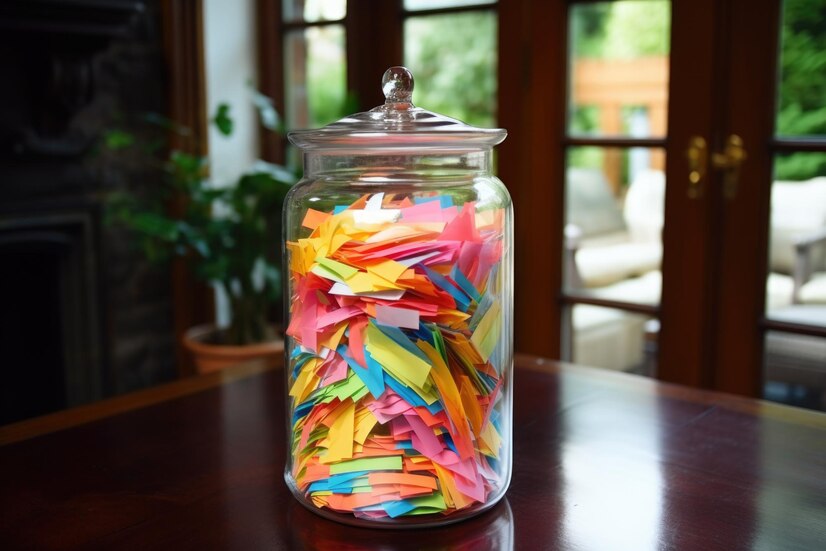
By keeping a record of all your Got Dones, you have an instant sense of achievement list that you can look at whenever you feel like you haven’t been productive on any given day.
There will be days when you are not as productive or efficient. But, again, we all have those days! The key on those days is to be kind to yourself. Refocus as often as you need to and get done what you get done. Even a couple of got dones a day still adds to the goal you are striving towards!
What Do You Think?
I’d love to hear your thoughts on this from you and hope this information helps you manage your daily activities more efficiently! Remember, no-one can manage time. We simply manage activities.
If this resonates with you and you want to discuss it further, then get in touch today. Either here or through any of my social medias or schedule a call to discuss it with me directly.
I love hearing from my readers and finding more ways to help them individually! I look forward to speaking with you soon and hope this post helps you to start living to your fullest potential.
Have a great rest of your day!
Jaiye