


Welcome to reThink Your Perspective’s blog. Helping you to unlock your potential, empower your mindset, create productive habits, and boost your motivation. Today’s topic compares the difference between growth and fixed mindset.
You can listen to this blog as a Podcast HERE.
The Difference Between Growth And Fixed Mindset
We all have beliefs, mostly unfounded, about our own potential, skills and abilities. These beliefs are the basis of our paradigm, and I have discussed this in a previous post. The focus of todays post is to discuss the difference between a Growth and Fixed Mindset.
As I said previously, mindset is incredibly powerful. It shapes our everyday lives, impacts our behaviour, and predicts our levels of success. We cannot outperform the image we hold of ourselves in our subconscious mind, and our mindset is set by that image. If you believe yourself to be shy, then your paradigm will make you very uncomfortable if you try to do something brave. If you can even contemplate doing it in the first place!
Carol Dweck
Dr. Carol Dweck is a leading researcher into mindsets at Stanford University. She discovered two main types of mindsets after becoming interested in student’s attitudes about failure over 30 years ago. The researchers noticed that some students rebounded from failure, while others were devastated by even the smallest setbacks and unable to try again. Some students believed that they could get smarter by putting more effort and time into their learning, while others refused to accept that they could improve on their current abilities.
She coined the terms growth and fixed mindset to describe the underlying beliefs that people have about themselves, their intelligence and their ability to learn.
Brain Plasticity
As briefly mentioned in my previous post, the brain is far more malleable than we ever knew.
The study of brain plasticity and recent advances in neuroscience have shown that connectivity between neurons can change. With practice, neural networks can grow new connections, strengthen existing ones, and speed up transmission of impulses. This shows that the actions we take, using good strategies, asking questions, following good nutrition, getting enough sleep and practicing can increase our neural growth. It has even been shown that neurons in the brain can be repurposed to replace those damaged by injury or stroke.
Alongside the neuroscientific discoveries, researchers began to understand the link between success and achievement. They noted that those who succeeded, believed their talents, skills and intelligence could grow, they therefore behaved differently. So the researchers started asking the question “Can we change mindsets? And if so, how?“. This started further studies and interventions that prove we can change our mindset. When we do, it leads to increased motivation (the can do attitude) and achievement.
This leads us onto the difference between a growth and a fixed mindset, and how you can adjust yours accordingly.
What is a Fixed Mindset?
Having a fixed mindset means you believe your intelligence, beliefs, education, talents and personalities are fixed and cannot grow. They are set in stone at birth and you cannot learn anything new. That you are born with a certain ability level, with or without special skills, and are unable to improve your abilities any further.
It’s the “I can’t do it and I’ll never be able to do it” mindset.
It is also found in people who know they can, who believe they are one of the special ones born with great abilities (or seen as such by others). But yet do not use their abilities through fear of failing and losing their label of great or special.
People with a fixed mindset naturally avoid challenges, obstacles, small setbacks and any opportunity where they could make a mistake. Their desire to ‘look smart’ in front of others trumps ever trying or learning something new.
See this information in video form here:
https://www.youtube.com/watch?v=Fep-RltmjzE
Carol Dweck’s Findings
Dweck’s work found that as many as 40% of students have a fixed mindset. These students tend to give up easily, resent their peers when they achieve something, feel pressure to prove their intelligence, and avoid trying to complete anything they think they could fail. She also found that most people have at least some qualities of both fixed and growth mindsets.
“As you begin to understand the fixed and growth mindsets, you will see exactly how one thing leads to another — how a belief that your qualities are carved in stone leads to a host of thoughts and actions, and how a belief that your qualities can be cultivated leads to another host of different thoughts and actions, taking you down an entirely different road.”
Carol Dweck
Does This Resonate With You?
Having a fixed mindset is different to realising that you have a fixed mindset. Once you realise you have a fixed mindset, you can choose to do something about it. It is your choice what you consciously think about, so if you notice you are resisting doing something due to believing you can’t do it, or that you might fail, take a breath and just go for it! Or seek support to help you do it.
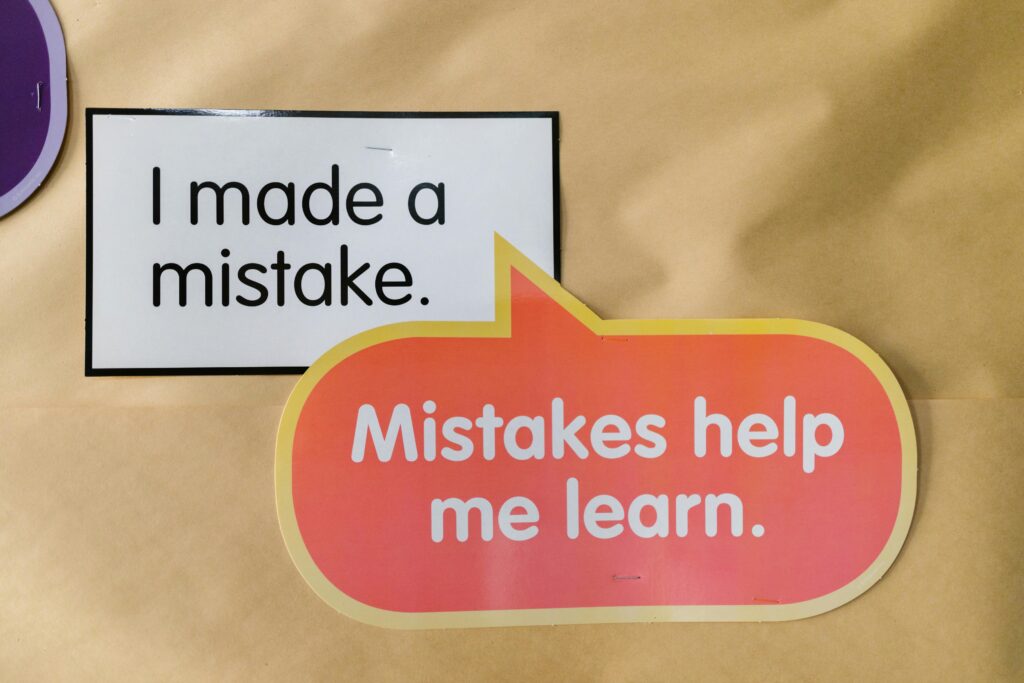
Mistakes are necessary to growth! You believe that you will be ridiculed for making a mistake. There is a good chance that you won’t! And that people will support you even more for trying to do something new. Your mistake could be celebrated!
I celebrate all my mistakes, then I learn from them and try again.
What is a Growth Mindset?
A growth mindset occurs when we believe our intelligence, talents, ability and education can all be improved. It is also believed that any skill a person wants to learn can be learnt, with effort and the right strategies.
It’s the “I can do it; I just need to keep trying” approach. It is not necessarily the need to try or work harder, but the mindset of working smarter. Looking for alternative options and approaches. Not being afraid to ask for help.
A passion for learning, a willingness to confront challenges, and viewing failures as opportunities for growth spurts, are all characteristics associated with having a growth mindset.
What Are The Benefits of Having a Growth Mindset?
Not surprisingly, having a growth mindset is strongly linked to greater happiness and achievement in life. These people are able to ask for help in order to grow their skills and are willing to keep trying new approaches in order to reach their goals.
They do have setbacks, everyone does! But they are able to see the setback for what it is, a temporary roadblock, without attaching too much emotion. This allows them to be able to analyse what happened and then try a different way rather than giving up, or not trying in the first place.
What Do You Think?
Having a growth mindset sets you up for greatness. You accept that mistakes are necessary to growth and don’t allow a fear of judgement, failure or ridicule to hold you back from doing the things you want to do in your life. You are resilient, you keep trying, and you seek out challenges. Looking for the opportunity in every challenge will only ever allow you to live a positive and fulfilling life.
If you want to learn more about growth and fixed mindset and how you can shift yours if you need to, then get in touch today. Either here or through any of my social medias or schedule a call to discuss it with me directly. My purpose is to get people out of their own way and find the life they want to live. To get in touch with the person they want to be.
I’d love to discuss this further with you to help you get your mindset shifting. Please comment, like or subscribe!
Take care,
Jaiye