

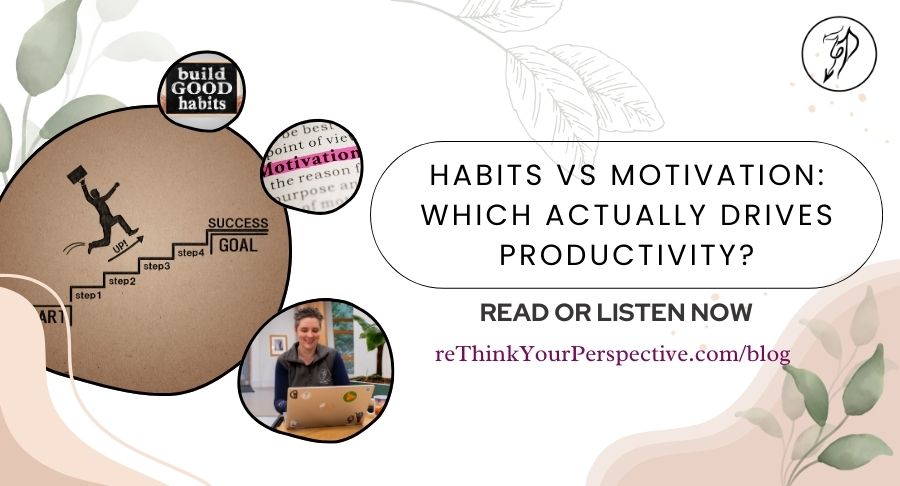
Welcome to reThink Your Perspective’s blog. Your trusted space for unlocking potential, empowering mindsets, building productive habits, and boosting motivation. Today we are exploring habits vs motivation, why motivation fades, and how habits create consistent productivity even on low-energy days.
Prefer to listen instead? You can access this blog as a podcast HERE. Don’t forget to join our mailing list for weekly updates and powerful tools to support your growth.
The Productivity Myth We’re Often Told
When people talk about productivity, motivation is usually the first thing mentioned.
We hear phrases like:
- “Just stay motivated.”
- “You need more discipline.”
- “Find your motivation again.”
But anyone who has tried to build new habits knows something important: motivation doesn’t stay the same.
Some days you feel energised and ready to tackle everything on your list. Other days even simple tasks feel harder than they should.
This is completely normal.
Motivation naturally rises and falls. Habits, on the other hand, provide stability when motivation disappears. Understanding the difference between habits vs motivation can change how you approach productivity entirely.
What Motivation Actually Is
Motivation is the emotional drive that pushes you to take action.
It often appears when:
- You feel inspired
- You start something new
- You see a clear goal ahead
- You experience a burst of energy or excitement
Motivation can be incredibly helpful in the early stages of change. It helps you begin.
However, motivation is influenced by many factors, including:
- Sleep
- Stress
- Energy levels
- Workload
- Mood
- Life circumstances
Because these variables constantly change, motivation fluctuates too.
This means motivation is a spark, not a long-term system.
Why Motivation Naturally Fades
Many people believe motivation disappears because they “lost discipline”. In reality, motivation fades because the brain adapts quickly.
When you start something new, the brain responds to novelty. New experiences release dopamine, which creates excitement and energy.
But as the behaviour becomes familiar, that novelty fades.
Add in everyday pressures like work responsibilities, family commitments, and unexpected challenges, and motivation becomes even less reliable.
This is why productivity strategies built solely on motivation often fail.
Not because people lack commitment, but because motivation was never designed to sustain behaviour long-term.
The Stability of Habits
Habits operate differently from motivation.
A habit is a behaviour that has been repeated often enough to become automatic or semi-automatic.
Instead of relying on emotional energy, habits rely on cues and repetition.
For example:
- Brushing your teeth before bed
- Locking the door when leaving the house
- Checking your calendar in the morning
You rarely rely on motivation for these behaviours. They simply happen because the habit has been established.
This is where habits become powerful for productivity.
When habits support your work and routines, productivity becomes steadier because actions are no longer dependent on how you feel in the moment.
Habits Reduce Decision Fatigue
One of the biggest advantages habits have over motivation is that they reduce decision fatigue.
Decision fatigue occurs when your brain becomes tired from making too many choices.
Throughout the day you make countless decisions:
- What to focus on
- When to start
- Whether to continue
- What to prioritise next
If productivity relies on motivation, every task becomes a negotiation with yourself.
Habits remove much of that negotiation.
When a behaviour becomes habitual:
- You start faster
- You question it less
- You spend less mental energy deciding
This frees up mental space for meaningful work rather than constant self-management.
Motivation Starts the Journey. Habits Continue It
This doesn’t mean motivation has no role.
Motivation is extremely useful when starting something new. It provides the energy needed to take the first step.
But habits are what carry behaviour forward once the novelty disappears.
Think of it this way:
Motivation helps you begin writing a new project -> Habits help you sit down and write even when you’re tired.
Motivation encourages you to start exercising -> Habits get you out the door when enthusiasm fades.
Productivity improves when habits take over the work motivation started.
Real-Life Examples of Habits vs Motivation Supporting Productivity
Small productivity habits can make a significant difference over time.
For example:
A Morning Priority Habit
Instead of relying on motivation to decide what matters each day, spend two minutes each morning identifying your top task.
This creates clarity before distractions appear.
A Focus Start Habit
When opening your laptop, begin with five minutes of focused work on your most important project before checking email.
This protects deep work before reactive tasks take over.
An End-of-Day Reset Habit
Before finishing work, write down tomorrow’s first task.
This reduces mental clutter and makes starting the next day easier.
How to Build Habits That Replace Motivation
Building habits doesn’t require dramatic change. It requires thoughtful design.
Here are a few simple strategies.
Start Smaller Than Your Ambition
Large habits rely heavily on motivation.
Smaller habits repeat more easily.
Five minutes of focused work is easier to repeat than an hour.
Consistency matters more than scale.
Attach Habits to Existing Routines
Linking a new habit to something you already do creates a natural cue.
For example:
After I make my morning drink, I will review my priorities.
This removes the need to remember or rely on motivation.
Reduce Friction
Habits succeed when the environment supports them.
Simple adjustments can include:
- Keeping tools visible
- Reducing distractions
- Creating dedicated work spaces
When friction decreases, habits require less effort.
Focus on Identity
One of the most powerful ways to sustain habits is to link them to identity.
Instead of asking:
“How do I stay motivated?”
Ask:
“What would someone who values calm, consistent productivity do here?”
Identity-based habits feel meaningful rather than forced.
Productivity That Doesn’t Depend on Mood
When productivity depends entirely on motivation, it becomes unpredictable.
Some days everything flows. Other days even simple tasks feel overwhelming.
Habits create stability because they continue working regardless of mood, energy, or circumstances.
Over time, this consistency compounds.
Small actions repeated daily often create far greater progress than occasional bursts of motivated effort.
What Do You Think? Habits vs Motivation?
Motivation is powerful, but it is temporary.
Habits are quieter, but they are far more reliable.
When productivity relies only on motivation, progress becomes inconsistent. When habits support your routines, productivity becomes steadier and more sustainable.
Motivation may start the journey.
Habits are what carry you forward.
So a gentle question to reflect on:
What habit could replace motivation in one area of your work or life?
That shift is often where real consistency begins.
If this inspired you to reThink your own habits, explore my other posts in the Knowledge Centre, or to learn more about how I can help you apply these principles in your own life. You can:
- Message me here
- Connect on social media
- Or book a free discovery call
To your continued success,
Jaiye