

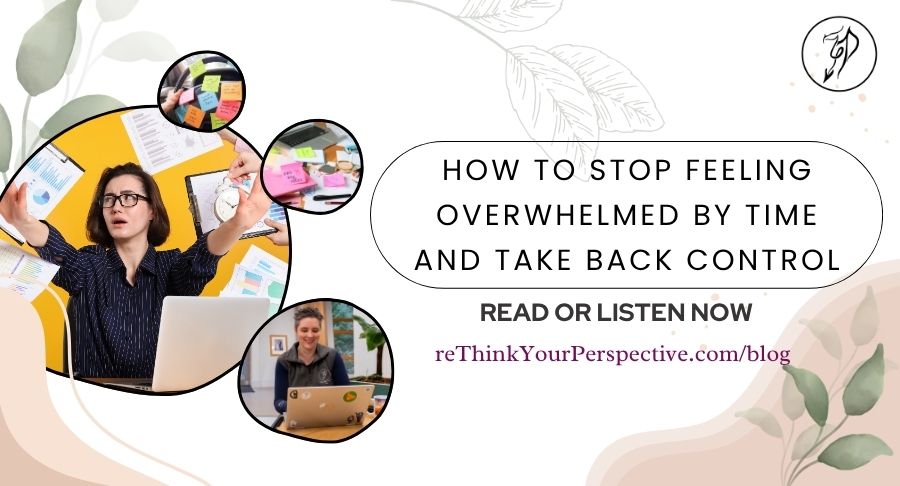
Welcome to reThink Your Perspective’s blog. Your trusted space for unlocking potential, empowering mindsets, building productive habits, and boosting motivation. Today we are learning calming, practical ways to reduce pressure, regain focus, and feel more in control of your day to help you feel less overwhelmed by time.
Prefer to listen instead? You can access this blog as a podcast HERE. Don’t forget to join our mailing list for weekly updates and powerful tools to support your growth.
Do You Ever Feel Overwhelmed By Time?
That feeling can creep in before the day has even properly started.
You wake up already thinking about everything that needs doing. The emails waiting. The jobs you did not finish yesterday. The messages you need to reply to. The thing you promised someone. The task you keep putting off. The appointment later. The pile of little things that all seem to need attention at once….
Before long, your mind is not just thinking about today. It is trying to carry tomorrow, next week, and every unfinished task from the past as well.
No wonder it feels heavy!
When you feel overwhelmed by time, it is easy to assume the problem is that you simply do not have enough of it. You might tell yourself you need to get more organised, wake up earlier, work faster, or somehow squeeze more into the day.
But often, the issue is not time itself.
It is the pressure, the mental load, the lack of clarity, and the emotional weight of feeling like you are always behind.
The good news is that you do not need to fix your whole life in one day to start feeling more in control. You can begin by calming the pressure and choosing one useful next step.
Why feeling overwhelmed by time is so stressful
Time pressure can feel different from ordinary busyness.
Busy can sometimes feel energising. You have things to do, but there is still a sense of movement and direction.
Overwhelm feels different. It often feels like everything is urgent, everything matters, and there is no clear place to begin.
You may notice that your thoughts start racing. You keep jumping from one task to another in your mind, even if you are not actually taking action. Simple decisions feel harder than they should. You might feel tense, snappy, tired, scattered, or unable to properly switch off.
For some people, feeling overwhelmed by time shows up as procrastination. Not because they do not care, but because the pressure has made the task feel too big to start. For others, it shows up as constant rushing, overworking, or trying to do ten things at once.
Either way, the real issue is not laziness.
It is overload.
Signs that time pressure is affecting you
When time pressure builds up, it can affect how you think, feel, and behave. You might recognise some of these signs:
- feeling behind before the day begins
- rushing, even when nothing is immediately urgent
- struggling to focus on one task
- feeling guilty when you rest
- constantly replaying unfinished jobs in your mind
- avoiding tasks because they feel too much
- becoming irritated by small interruptions
- feeling busy all day but not satisfied by what you achieved
These signs are not proof that you are bad at managing time. They are signals that your mind and body may be carrying too much pressure.
Awareness matters here, because once you notice what is happening, you can respond differently. You can’t change something you aren’t aware of!
The first step is to calm the noise
When everything feels urgent, your first instinct may be to move faster.
But when your mind is overloaded, speed is not always the answer. In fact, rushing can make things feel even more chaotic.
The first step is often to slow down just enough to see clearly.
That might sound too simple, but even a short pause can help interrupt the spiral of “everything needs doing now”.
Try taking two minutes to breathe, step away from the screen, make a cup of tea, or write down what is circling in your head. The aim is not to avoid the work. The aim is to give your brain enough space to stop juggling everything internally.
A useful starting question is:
“What is actually asking for my attention right now?”
Not everything. Not the whole week. Just right now.
Get everything out of your head
One reason time overwhelm feels so intense is that your brain is trying to hold too many open loops at once.
Tasks, reminders, decisions, worries, appointments, and ideas all compete for attention. When they stay in your head, they can feel bigger and more urgent than they really are.
This is where a simple brain dump can help.
Take a piece of paper or open a blank document and write down everything that is taking up mental space. Do not organise it at first. Do not judge it. Just get it out.
Once it is visible, you can begin to separate things.
You may notice that some tasks are urgent, some are important but not immediate, some can wait, some can be delegated, and some are not actually yours to carry.
That alone can bring relief, because your mind no longer has to keep shouting reminders at you.
Choose one priority before choosing a plan
When you are overwhelmed by time, creating a full detailed plan can sometimes become another source of pressure.
Instead of trying to schedule every minute, start with one priority.
Ask yourself:
“If I could only move one thing forward today, what would matter most?”
This question helps cut through the noise. It does not mean other things are irrelevant. It simply gives your day a centre point.
For example, your priority might be completing a piece of work, making an important phone call, preparing for a meeting, booking an appointment, or sorting one thing at home that has been weighing on your mind.
Once you know the priority, the next step becomes easier. You are no longer trying to solve the whole day at once. You are choosing where to place your attention first.
Break the next step down until it feels doable
Overwhelm often grows when a task feels too big, too vague, or too emotionally loaded.
“Sort the finances” feels heavy.
“Catch up on everything” feels impossible.
“Fix my routine” feels too broad to start.
The trick is to make the next step smaller and clearer.
Instead of “sort the finances”, the next step might be “open the banking app and check the balance”. Instead of “catch up on everything”, it might be “reply to the three most important emails”. Instead of “fix my routine”, it might be “choose tomorrow’s first task before going to bed”.
A smaller step is not a weaker step. It is often the step that actually gets done.
When your nervous system is already under pressure, small and clear is far more useful than big and vague.
Create a simple boundary around your focus
Feeling overwhelmed by time often gets worse when your attention is constantly interrupted.
You may already feel behind, then every notification, message, request, or distraction pulls you further away from the task in front of you. This makes the day feel more fragmented, which adds to the pressure.
You do not need to create a perfect quiet environment. Most people cannot.
But you can create one small boundary.
That might be putting your phone out of reach for 25 minutes, closing your inbox while you work on one task, telling someone you will come back to them after a focus block, or setting a timer so your brain knows it only has to concentrate for a short time.
A protected focus block helps you rebuild trust with yourself. It reminds you that you can still move something forward, even when the day feels full.
Stop measuring your day by what is unfinished
One of the reasons people feel overwhelmed by time is that they only measure the day by what is still left to do.
And because there is almost always something left to do, the day ends with a sense of failure.
This can become exhausting.
Instead, try adding a short “got done list” at the end of the day. Write down what you did complete, what you moved forward, or what you handled that required energy.
This is not about pretending everything is perfect. It is about giving your brain a fuller picture.
You may not have finished everything, but that does not mean you did nothing.
Recognising progress helps reduce the feeling that you are constantly failing at time.
Give yourself permission to pause
When you feel behind, rest can feel irresponsible.
But pushing through without any recovery usually makes overwhelm worse. Your focus drops, your patience gets thinner, and tasks take longer because your brain is tired.
A pause does not have to be long.
It might be five minutes away from your screen, a short walk, a drink of water, a few slow breaths, or sitting quietly before moving to the next task.
The point is to stop treating yourself like a machine that should be able to keep going without maintenance.
You are allowed to pause before everything is finished.
In fact, pausing may be what helps you finish more calmly and effectively.
Take back control one choice at a time
Taking back control does not mean controlling everything.
That is impossible.
It means choosing where your attention goes next. It means noticing what is adding pressure and making one small adjustment. It means recognising that you do not have to solve the whole day, week, or year in one sitting.
If you are feeling overwhelmed by time, begin with these four steps:
- write down what is circling in your head
- choose one priority
- break the next step down
- protect a short focus block
That is enough to begin.
Small choices repeated consistently can create a much calmer relationship with your day.
Where To Go From Here
If this has resonated with you, you’ll likely find this next step really valuable.
I recently delivered a talk that explores this idea in more depth:
“What if lack of time isn’t the issue?”
It challenges the way we think about time, and offers a fresh perspective on what actually makes a difference. Take a look here:
Because maybe the answer is not to find more time.
Maybe it is to focus more clearly on what matters.
What Do You Think?
Feeling overwhelmed by time can make it seem as though you need more hours, a better planner, or a completely different routine.
Sometimes those things help.
But often, the deeper need is clarity, calmer thinking, protected focus, and permission to stop carrying everything at once.
When you stop trying to manage the whole of time and start choosing your next useful action, the pressure begins to shift.
If this has inspired you to reThink your own time management, explore my other posts in the Knowledge Centre. Or to learn more about how I can help you apply these principles in your own life, you can:
- Message me here
- Connect on social media
- Or book a free discovery call
To your continued success,
Jaiyé