


Welcome to reThink Your Perspective’s blog. Helping you to unlock your potential, empower your mindset, create productive habits, and boost your motivation. Today I am sharing 4 tips to help you build new habits the easy way.
You can listen to this blog as a Podcast HERE.
4 Tips To Build New Habits
A lot of this information I learnt from James Clear and his Atomic Habits approach.
Tip #1 To Build New Habits – Habit Tracking
Habit tracking is the simple activity of ticking off something each time you do your new habit.
For me, I created a specific page in my diary to tick off everyday I do my morning routine habit that sets me up for the day! I wake up, do a meditation and listen to my self-recorded self image. Then I do a yoga session before writing my goal, reading my affirmations and doing my morning study session.
How Does Habit Tracking Work?
Firstly, I want to point out that to reach any goal or resolution you have set, you need to change your habits. Your current habits are in line with where you are right now. To do something differently you need to change your habits, or you will not achieve your goal.
So, step one of habit tracking is to decide on what habit you want to change.
You can’t just stop doing a bad habit, you have to replace it with a good one. So using the morning routine example, I want to start the day positively instead of sleeping in. Sleeping in is the bad habit I want to change. So I am replacing it with my morning routine to start each day in a more productive way.
Once you know what habit you are building (work on one at a time!), you can then tick off each time you do it!
Step 2 is to have a way to track your new habit and when you do it.
As mentioned above, I will track my morning routine by ticking off each session on a pre-designed sheet. Other options could be:
- Using a calendar month overview.
- A grid of 30 squares (or however many you need) and tick or colour each one as I go.
- Putting a tick on each day of your wall calendar or diary.
- Using a grid similar to the one in the photo of this article.

Whichever way works best for you to build a visible record of how many times you have completed your new habit. The idea is that this visual record of achievement will boost your enthusiasm towards completing the habit each time you come to do it.
The more ticks you add, the harder it becomes to not do the habit! You hold yourself to account by wanting to add as many ticks as possible. This is why Duolingo is so effective with its streak calculators!
And before you know it you will be doing the habit automatically.
Tips To Boost Your Motivation Further And Build New Habits Easily
There will be days when you simply don’t want to do that new habit! Your paradigm will want to do the easier old habit instead. And that is perfectly normal! I fully expect to have mornings where I want to sleep in instead of do my morning routine. Or days when I am just not in the mood…
But to help you there are a few things you can do to make your new habit even easier. The biggest one being getting everything set up for your habit in advance.
In my morning routine example
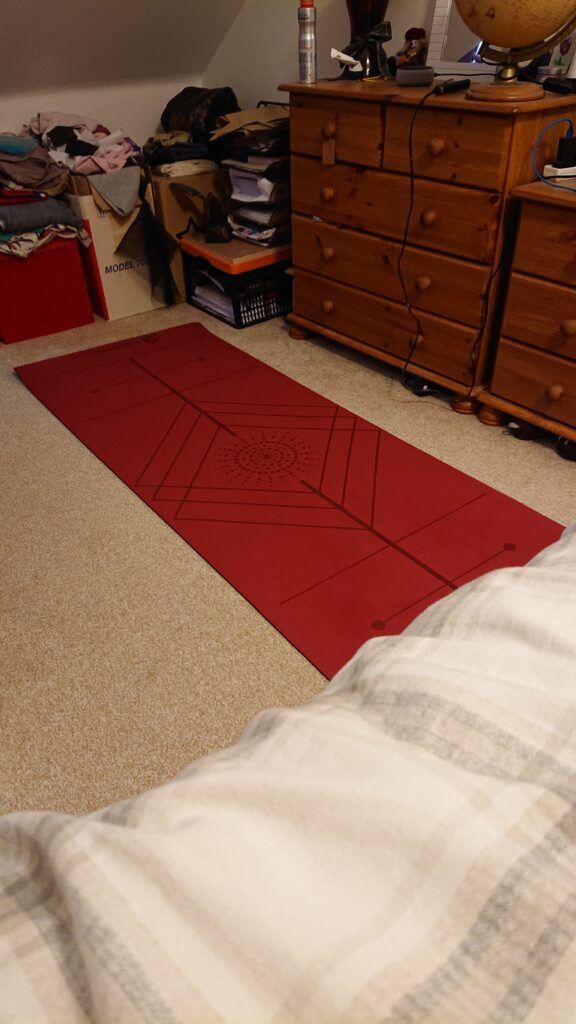
this consists of having my headphones next to the bed for my meditation. As well as setting out my Yoga mat and study materials before I go to bed. Having everything I need in easy reach of the mat or my desk. I also have a yoga playlist saved on the YouTube app on my phone.
When I get up in the morning, all I have to do is first put my headphones in for my meditation. Then go to the mat and press play on a video! This preparation minimises any morning faffing or extra work making it as easy to get going as possible.
If your new habit is to stop eating as much sweet stuff, a good preparation would be to remove all the sweet things from your house.
If you are wanting to be more productive, then get everything organised. Start using a Get Done list instead of a to do list. Set up your workstation to have as few distractions as possible. Set your work timings and have an automatic schedule on your phone that mutes notifications during those times.
Check out this video to learn more about this tip!
Tip #2 To Build New Habits – Habit Stacking
Habit stacking is a technique for building new habits by attaching them to existing habits.
The idea is to choose a current habit that you already do regularly, and then add a new habit that you want to build after it. By linking the new habit to the existing one, you can use the cue and routine of the current habit to help trigger and perform the new habit. This makes it easier to incorporate the new habit into your daily routine and make it more likely to stick.
For example, let’s say you want to start meditating every day. One way to do this using habit stacking would be to choose an existing habit that you already do every day. Like brushing your teeth in the morning. You could then add your meditation routine immediately after brushing your teeth. The act of brushing your teeth serves as a cue to start meditating.
Over time, the combination of brushing your teeth and meditating could become a new, combined habit. The more you do the habit, the stronger, more efficient and more automatic the connection in your brain becomes.
The Habit Stacking Formula
The formula for habit stacking is laid out by James Clear in his book Atomic Habits and looks like this:
After / Before [CURRENT HABIT],
I will [NEW HABIT]
In the meditation example above, this looks like:
After I brush my teeth in the morning, I will meditate for 2 minutes.
You then build up the amount of time you will meditate each day until you hit the time you want to spend. Building the time up slowly makes it easier and more convenient to start doing your habit more efficiently.
Another example could be that you want to start running every day. You could pair this with getting home from work as follows:
After I get home from work, I will go for a 5-minute run.
Again, start with a short time period, and build it up. If you are following a training plan then follow that. And another tip to make this habit easier and more convenient? Make sure, before you go to work, that your running kit is laid out ready to be put on. This saves faffing around looking for your left shoe! And also any chance of procrastinating or making an excuse not to go.
You can also make this set up part of your morning routine! You could add “lie out running gear” into the middle of your current morning routine. If your current routine looks like:
Wake up > Make my bed > Take a shower
You could change it to:
Wake up > Make my bed > Lie out my running gear > Take a shower
When you then get home from work, everything is there ready for you to do on autopilot with little thought on actually doing it!
Why Is Habit Stacking So Effective To Build New Habits?
Habit stacking is effective because it takes advantage of the psychological principles that underlie habit formation. Habits are formed through repetition and association, and habit stacking takes advantage of both of these factors.
By attaching a new habit to an existing habit, you create a strong association between the two. Which can make it easier to remember and perform the new habit. Additionally, by performing the new habit repeatedly in the context of the existing habit, you create opportunities for repetition. This can help reinforce the new habit and make it more automatic over time.
In addition to these psychological factors, habit stacking can also be effective because it allows you to build new habits incrementally. Rather than trying to tackle a new habit all at once. This can make it easier to stay motivated and committed to the new habit. You can focus on making small, incremental changes rather than trying to make a major overhaul to your routine all at once.
Habit stacking is like having a game plan for which action should come next. As you incorporate each new habit into your daily routines, you will find it easier and easier to develop the newer, more productive habits you need to reach your goals.
Slight Word Of Warning!
Habit stacking works best when the existing habit, the trigger for the new habit, is specific and immediately actionable. You have to make your habit stacks really specific.
For example, instead of “During my lunch break I will read a book”. Consider “After I eat my lunch, I will read a book for 5 minutes”. This makes it much more obvious when you will do your habit rather than questioning when you will read the book! Before you eat? After you eat? How long will I read for?
Make sure your trigger is specific and unambiguous. This will make it easier to build the habit consistently in a shorter period of time. The more consistent you are, the quicker the habit will become automatic.
View this second tip in video form:
Tip #3 To Build New Habits – Implementation Intentions
An implementation intention is a specific plan that you create in order to achieve a particular goal. It is a way of turning your goals into concrete actions by specifying exactly when, where, and how you will perform a particular behaviour. Research has shown that people who use implementation intentions are more likely to follow through on their goals and to achieve their desired outcomes. This makes it a very effective method to build new habits!
An implementation intention habit is a habit that you have formed by regularly using implementation intentions to achieve your goals. When you make an implementation intention a habit, you are more likely to consistently follow through on your plans and to achieve your desired outcomes. This can be particularly helpful when you are trying to develop new habits or make changes to your existing habits.
By using implementation intentions consistently, you can make it easier to stick to your goals and make progress towards achieving them.
And the best bit?
You don’t even need motivation to get on with the activity!
How Is An Intention Better Than Motivation?
Motivation is an important factor in achieving your goals, but it can be unpredictable and difficult to sustain.
An implementation intention is a specific plan that you create in order to achieve a particular goal. It can be a more effective way of achieving your goals because it helps you to turn your motivation into action.
When you create an implementation intention, you specify exactly when, where, and how you will perform a particular behaviour. This can help you to overcome the barriers and challenges that might otherwise prevent you from achieving your goals.
For example, if you want to start exercising regularly, you might create an implementation intention that says:
“I will go for a 30-minute walk every day at 6:00 PM, rain or shine.”
This implementation intention helps you to turn your motivation to exercise into a specific, actionable plan that you can follow consistently. As it is a set behaviour, you don’t need motivation to do it because you have already decided to.
In contrast, relying solely on motivation to achieve your goals can be less effective because motivation can be unpredictable and may not always be present when you need it. By creating an implementation intention, you can help to ensure that you follow through on your goals even when your motivation is low. This can make it easier to achieve your desired outcomes and to make progress towards your goals.
Is There A Formula?
As with habit stacking, there is a formula dictated by James Clear in Atomic Habits that, broadly speaking, states:
When situation X arises, I will perform response Y
Situation X can be any trigger that prompts you to do something. It could be your phone buzzing in your pocket – you are prompted to answer it. The smell of a food you love could prompt you to go and find it, or to feel hungry. The sound of sirens while you are driving prompt you to look around and ensure you are not in the way.
The two most common triggers are time and location. And it is those two that implementation intentions leverage. When you write down an activity with a date / time and location, you are scientifically proven to be more likely to show up and complete the activity.
People don’t lack motivation. They lack the clarity of when and where to do the habit that they want to start doing! Without clarity its hit and miss whether you do the activity or not. And the lack of consistency will halt all progress towards your goal.
Check out the video to learn more about this tip!
Tip #4 To Build New Habits – Temptation Bundling
Temptation bundling is a strategy that involves combining a desired activity (something that you want to do) with an undesired activity (something that you need to do but might not enjoy). By bundling the two activities together, you can make the undesired activity more appealing and enjoyable. And you may be more likely to follow through on it.
For example, if you want to watch a TV show but you also need to exercise. You might create a temptation bundle by only allowing yourself to watch the TV show while you are exercising on a stationary bike or treadmill. This can make exercise more enjoyable and help you to stick to your exercise goals. Even if you don’t particularly enjoy exercising on its own.
Temptation bundling can be an effective strategy for breaking temptation habits and for helping you to follow through on your goals. Especially if you struggle to find the motivation to engage in certain activities. By linking the activity you need to do with something that you enjoy, you can make it more rewarding and enjoyable. And you may be more likely to follow through on it.
How to Create Your Temptation Bundle To Build New Habits
You first need to create two lists. One of things you need to do, the second of things you like to do.
Secondly, you then pair up things from one list with the other. For example:
- You need to check and respond to your emails. You want to get a pedicure. Check your emails while having your pedicure!
- That ironing isn’t going to do itself. You want to watch your favourite TV show. Do the ironing in front of the TV!
- You need to finish that drawing. You want to listen to a podcast or audiobook. Do the drawing while listening to the podcast!
These bundles will be different for everything. So get very clear on the things you need and want to do and then work out which ones you can bundle.
Will This Work For Everything?
As with most things, no. It won’t. It would be very difficult to write a report whilst listening to an audiobook or watching TV! Or to get a manicure while trying to write a blog post! But you can still use your guilty pleasure as a bribe.
Tip #3 discussed implementation intentions, and that idea can be perfectly combined with temptation bundling in the following way.
I will only do [THING YOU WANT TO DO],
after I have done [THING YOU HAVE TO DO]
So it could be that you will only watch TV once you have finished the report. Or, for me, I will only go on the sewing machine once I finished my blog posts!
It gives you the incentive to get the thing done so you can do the thing you want to do. Obviously, this requires discipline on your part to not just go do the thing you want to do! But if that gets tempting, remember this. You will enjoy the thing you want to do so much more if you don’t have that guilty feeling that you should be doing the thing you need to do!
This video will help explain some more!
What Do You Think?
I hope these 4 tips to build new habits resonates with you. Please share your thoughts below. If you want to discuss it further then get in touch today. Either here or through any of my social medias or schedule a call to discuss it with me directly.
Please comment, like or subscribe! I love hearing from my readers and finding more ways to help them individually! So I look forward to speaking with you soon and hope this post helps you start shifting those habits that no longer serve you and the life you want to live!
To your success,
Jaiye