

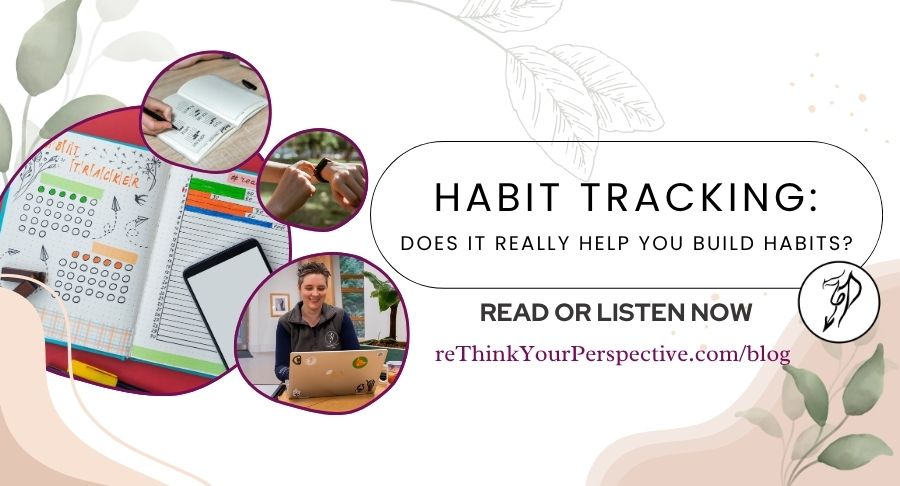
Prefer to listen instead? You can access this blog as a podcast HERE. Don’t forget to join our mailing list for weekly updates and powerful tools to support your growth.
We hope that you get some benefit from these blog posts, and we would love to hear your thoughts! Don’t hesitate to like, share and comment at the links at the bottom of the post.
Habit Tracking: Does It Really Help You Build Better Habits?
Have you ever started a new habit with plenty of enthusiasm, only to realise a week later that you have no idea how often you have actually done it?
Perhaps you planned to drink more water, take regular breaks, start work with your top priority or spend ten minutes each day on an important goal (as we discussed in the last episode on Habit Stacking!).
You completed the habit a few times. You forgot on other days. Life became busy, your attention moved elsewhere, and eventually the habit quietly disappeared.
This can make it feel as though you are incapable of being consistent…
But in reality, you may simply lack a clear picture of what is happening.
That is where habit tracking can help.
Habit tracking gives you a simple record of when you complete a habit. It can make progress visible, reveal useful patterns and remind you that small actions count.
However, it is not magic.
A tracker cannot make you do the habit, and tracking everything perfectly will not automatically make you more productive.
Used well, habit tracking supports awareness and consistency. Used badly, it can become another task, another source of pressure or another reason to criticise yourself.
So, should you track your habits?
Yes, if the tracker helps you learn, notice progress and return to the habit.
Probably not if it creates more stress than the habit is worth.
What Is Habit Tracking?
Habit tracking simply means recording each time you complete a chosen behaviour.
You might place a tick on a calendar, colour in a square, make a note in your planner or tap a button in an app.
For example, you could track whether you:
- Wrote down your top priority.
- Completed a focused work block.
- Took a proper lunch break.
- Went for a walk.
- Drank enough water.
- Read one page.
- Stopped work at your planned finishing time.
The method matters less than the purpose.
You are creating a visible record of your actions so you can see what you are actually doing, rather than relying on memory or feelings.
That distinction is important.
You might feel as though you “never” follow through, then discover you completed the habit four times last week. Equally, you might believe you are doing something regularly and notice it has only happened twice this month.
Neither result is a reason for judgement. It is information you can use.
How Tracking Can Help You Build Better Habits
Habit tracking works best when it helps you understand yourself.
A row of ticks can feel satisfying, but the real value lies in what the record teaches you about your behaviour.
It Makes Your Progress Visible
Many habits produce results slowly.
One walk may help you feel better, but it will not transform your energy overnight.
One focused session will move a project forward, but it may not create an obvious result straight away.
Because the outcome takes time, it can be easy to believe nothing is changing.
A habit tracker gives you evidence of the actions you are taking before the bigger result appears.
Instead of thinking, “I’m getting nowhere,” you can see that you protected your focus on four mornings, walked three times or took a proper break every working day.
Those actions matter.
Productivity is not only measured by finished projects. It is also built through the repeated behaviours that make progress possible.
It Builds Awareness of Your Patterns
Habit tracking can show you more than whether you completed the habit.
It can reveal when the habit is easiest, when it tends to disappear and what may be affecting your consistency.
Perhaps you complete your focus habit on mornings when you plan before checking emails.
Maybe your lunchtime walk happens on quieter days but disappears whenever meetings run over.
You might notice that your evening routine works during the week but falls apart at weekends because the trigger is different.
This information allows you to ask better questions.
Rather than saying, “Why can’t I stick to anything?” you can ask:
- What helped on the days this worked?
- What got in the way on the days it did not?
- Is the habit too big?
- Does it happen at the wrong time?
- Do I need a clearer trigger?
- Am I expecting this habit to work when my energy is at its lowest?
Awareness gives you something practical to change.
It Creates Gentle Accountability
A habit tracker can act as a small reminder that you made a commitment to yourself.
Seeing the empty space may prompt you to complete the habit. Adding a tick can give you a sense of satisfaction and encourage you to continue.
However, accountability should feel supportive rather than punishing.
The aim is not to earn a perfect score. It is to notice whether the habit is becoming part of your life.
If you miss a day, the tracker has not exposed your failure. It has simply recorded what happened.
You can begin again at the next opportunity.
It Helps You Adjust What Is Not Working
Sometimes the problem is not your commitment. The habit itself may need changing.
Imagine you want to write for thirty minutes every morning, but your tracker shows that it rarely happens.
Instead of pushing harder, look at the pattern.
Perhaps mornings are already full. Maybe thirty minutes feels too demanding. You might be more focused later in the day, or a ten-minute starting habit may be more realistic.
The tracker gives you permission to experiment.
You could shorten the habit, move it, connect it to an existing routine or prepare what you need in advance.
Changing the plan is not cheating. It is how you create a habit that works in your actual life.
When Tracking Stops Being Helpful
Habit tracking is a tool, and every tool has limits.
It stops being useful when maintaining the tracker becomes more important than the reason you started the habit, such as:
When You Become Too Focused on a Perfect Streak
Watching a streak grow can feel motivating. The danger appears when keeping the streak becomes the entire goal.
You may complete the smallest possible version merely to preserve the number, even when rest would be more helpful. Missing one day can then feel so disappointing that you abandon the habit altogether.
Consistency does not mean doing something perfectly every day.
It means returning often enough for the behaviour to become part of your life.
A broken streak does not erase the actions you completed before it. Nor does it prevent you from continuing tomorrow.
When You Try to Track Too Much
Tracking ten or fifteen habits at once may look impressive in a new planner.
It can also become exhausting.
You have to remember every behaviour, record each one and process a large collection of results. Before long, habit tracking itself becomes another job.
Start with one habit.
Choose the behaviour that would make the most useful difference to your energy, focus or consistency. Once it feels established, you can decide whether tracking something else would genuinely help.
More data does not always create more progress.
When the Tracker Becomes Another Source of Pressure
Habit tracking should not become a daily report card on whether you were “good enough”.
Your life will affect your habits. Illness, school holidays, deadlines, tiredness, caring responsibilities and unexpected events all change what is realistic.
A tracker cannot understand the full context behind an empty box.
You can.
Treat the record with curiosity. Use it to notice patterns and make choices, not to prove that you lack discipline.
Which Habits Are Worth Tracking?
The best habits to track are specific actions you can clearly recognise as completed.
“Be productive” is too vague.
“Complete one thirty-minute focus block” is trackable.
“Take better care of myself” is unclear.
“Take a proper lunch break away from my desk” gives you a definite behaviour to record.
Useful habits might include:
- Writing your three priorities before checking emails.
- Spending ten minutes on your most important project.
- Taking a five-minute movement break.
- Putting your phone away during focused work.
- Reviewing your Get Done list at the end of the day.
- Preparing tomorrow’s first task before finishing work.
- Stopping work by an agreed time.
Choose an action that is within your control.
You cannot directly track “have a productive day” because results depend on many things. You can track whether you carried out the habit that supports a productive day.
How to Start Habit Tracking Without Making It Complicated
You do not need a complicated system, a detailed spreadsheet or the latest app.
A successful tracker is one you remember to use.
Choose One Specific Habit
Begin with one behaviour you want to understand or strengthen.
Ask yourself:
“What small action would make the greatest difference to my day?”
Perhaps your priority is protecting your focus. Maybe it is maintaining your energy or becoming more consistent with an important project.
Pick one clear action rather than trying to improve everything at once.
Decide What Counts as Completed
Define the habit before you begin tracking it.
If you are tracking movement, does five minutes count? When tracking focused work, how long is the focus block? If you want to read regularly, is the target one page or ten minutes?
Clear rules reduce the chance of moving the goalposts.
They also help you make the habit realistic.
A small version completed regularly is often more valuable than an ambitious version you continually avoid.
Pick the Simplest Tracking Method
The best tracking method is the one that fits naturally into your day. But the two main options are:
Paper Habit Trackers
You might use:
- A wall calendar.
- Your diary or planner.
- A printed grid.
- A notebook.
- A tick beside the habit on your Get Done list.
Paper works well when you enjoy writing things down or need the tracker to remain visible.
Digital Habit Trackers
Digital options include:
- A note on your phone.
- A recurring task.
- A calendar entry.
- A spreadsheet.
- A dedicated habit-tracking app.
Technology can be useful for reminders, but you do not need an elaborate tool. Adding a tick to a simple note is enough.
Choose convenience over novelty.
Review the Pattern, Not Just the Ticks
At the end of the week, spend a few minutes reviewing what happened.
Ask:
- How often did I complete the habit?
- When was it easiest?
- What helped me remember?
- What interrupted it?
- Did the habit improve my day?
- Should I keep it, change it or stop tracking it?
This review turns the tracker from a collection of ticks into something genuinely useful.
Without reflection, you only know what happened. With reflection, you begin to understand why.
Habit Tracking for Energy, Focus and Consistency
Habit tracking can support each part of sustainable productivity.
For energy, you might track breaks, movement, hydration or whether you stopped work before reaching exhaustion.
Focus, record the days you chose your priority before opening emails, put your phone away or completed an uninterrupted work block.
For consistency, track a small action connected to a meaningful goal, such as writing for ten minutes, contacting one potential client or reviewing your finances each week.
The goal is not to squeeze more into your day.
It is to notice whether your daily behaviour supports what matters.
A tracker should help you work with your energy, guide your focus and build a rhythm you can maintain without burning out.
Try This Simple Seven-Day Habit Tracking Experiment
Choose one habit to track for the next seven days.
Write it in clear language:
“After I make my morning drink, I will write down my top priority.”
Decide what counts as success. In this example, writing one priority is enough.
Choose a simple place to record it. A calendar, notebook or phone note will do.
Each day, mark whether you completed the habit.
At the end of the week, do not merely count the ticks. Look at the pattern.
What helped? What got in the way? Did the habit make a useful difference? What could make it easier next week?
You may decide to continue, adjust the habit or replace it with something more helpful.
All three choices are progress because you have learned something.
Final Thoughts: Track to Learn, Not to Be Perfect
So, should you track your habits, and does it actually help?
Habit tracking can help when it makes your actions visible, increases awareness and encourages you to keep returning to a useful behaviour.
It is less helpful when you track too much, chase perfect streaks or use every empty box as evidence against yourself.
Keep your approach simple.
Choose one meaningful habit. Decide exactly what you are tracking. Record it somewhere easy to access, then review the pattern with curiosity.
The purpose is not to prove you can be perfect.
It is to understand what helps you use your energy, focus and consistency more intentionally.
If habit tracking supports that, keep using it. If it starts creating more pressure than progress, simplify it or take a break.
The tracker works for you. You do not work for the tracker.
If this article has helped you think differently about tracking your habits, you can explore more articles in the reThink Your Perspective Knowledge Centre, join me for a free What Matters Wednesday productivity reset across my socials, or get in touch to find out how coaching can help you build habits that support your work, wellbeing and long-term goals.
To your success,
Jaiyé