

Principles of Success #4 – Specialised Knowledge
The first principle of today’s Principles Of Success is concerned with gaining specialised knowledge.
Napoleon Hill states in Think And Grow Rich that there are two types of knowledge: General and Specialised.
General knowledge is of little use in the accumulation of money, regardless of how much general knowledge you possess!
Knowledge must be organised and intelligently directed, through practical actions in order to accumulate money. Knowledge is only POTENTIAL power. Like electricity, knowledge only provides power when it is directed to a definite end or purpose.
Does A Good Education Help?
As a teacher by trade, I fully support the need for our education systems around the world. What I do not support is the iron fist approach that without an education our young people won’t succeed in their lives.
We constantly tell our children that they must get good grades in school to be able to get a good job and do the things they want to do in life.
Yes, good grades in school show that a child has an ability to learn and regurgitate information. But if we don’t teach them how to use that information practically, then it is just facts and nothing more.
There are plenty of people with really good degrees, and an abundance of knowledge, who are stuck in low paying jobs they hate. And equally there are people who came out of school with no grades at all who are earning millions.
One example from Think And Grow Rich was Henry Ford. He had little schooling and yet built the Ford Motor Company. Another example is Thomas Edison who was told he had to be schooled at home because the school could not meet the level of his genius. His mother told him this after receiving a letter to say he was not bright enough to attend school.
Education comes from the Latin ‘Educo’, meaning to educe, to draw out, to develop from within.
An educated person is not necessarily someone with an abundance of knowledge. They are someone who has developed the faculties of their mind to be able to receive anything they want without violating the rights of others.
The Difference Between General And Specialised Knowledge
Each of us have general knowledge in varying amounts. It is the day-to-day knowledge taught in schools, from older generations, and life experiences.
Specialised knowledge is usually gleaned from higher educational institutions, life experiences or in a job or workplace. Each of us is best served by focusing on one area of specialised knowledge and becoming an expert in just that one area.
You do not need to have all the different areas of specialised knowledge in order to run a business for example. Andrew Carnegie, once the wealthiest man in the world, openly said that he knew nothing of the technical side of the steel business. Yet he was the company founder and owner of a large steel manufacturer. He said that the specialised knowledge he required for the manufacture and marketing of steel he found available through other people. His mastermind.
And you too can gain all the knowledge you need without learning it yourself. It would be impossible for someone to be an expert in accountancy, public relations, steel manufacture, graphic design, sales or all the other areas of your chosen business. You can borrow other people’s knowledge to fill in your gaps.
How many business owners or self-employed people have an accountant? A lawyer? Social Media Manager? We outsource things we need to people who are specialists in that area. They will do a much better job than us all becoming a jack of all trades!
How Do I Decide Which Specialised Knowledge To Get?
Ultimately it is as simple as following your interests. Anything you are naturally interested in you will be more focused on. Some people like numbers and maths, others like drawing and creating things. Some people love to design and build, others like to do data entry and analysis. Its completely individual!
What is well known though is that employers give more consideration to people who take home study courses. They have learned from experience that anyone willing to give up their free time to study has those qualities which make for leadership. Those who have no ambition will not ‘give up’ their spare time to study. They are too engrossed and caught up in the latest TV program or computer game to even think about self-improvement.
As Eric Hoffer said:
“In times of change learners inherit the earth; while the learned find themselves beautifully equipped to deal with a world that no longer exists.”
Eric Hoffer
Those of us who keep learning and honing our skills cannot help but be successful in our chosen occupation!
By choosing a skill or area of knowledge that really resonates with you, you will never lose the motivation to keep learning and honing your skills. It becomes more like a hobby, an enjoyable experience, rather than a chore or requirement.
What skill will you hone?
Your Success Or Failure Hinges On Your Habits
Your habits will dictate your results. If you do nothing to expand your knowledge or skills except for times when your employer requires it, you will stay where you are in your life.
However, if you build habits of personal development, practise, skill honing and learning you cannot help but expand yourself out of your current position and reach the success you dream of and want for yourself.
Now lets move onto the next Principle Of Success.
Principles of Success #5 – Imagination
Imagination is the ability of the mind to create or form mental images or concepts of things that are not present in the physical world or are not perceived through the senses. It allows individuals to visualise, invent, or come up with new ideas and possibilities.
It is widely said that anything we can create in our mind, we can create in the physical world. If it were not physically possible then we would not be able to imagine ourselves doing it or having it.
Anything you want you simply have to see yourself with it already and really believe that you already have it! Then act as if you already have it until you get it.
How Can Getting What I Want Be That Easy?
It really is that simple! Your behaviour, results and circumstances are 95% controlled by your subconscious mind, your paradigms. Your subconscious mind, however, does not originate ideas! It can only accept whatever you tell it by using your conscious mind.
Your conscious mind houses your imagination. So you have conscious control over the images that you build in your conscious mind. Whatever you build consciously, you can impress on your subconscious mind by getting emotionally involved with it. Creating the physical feelings of the person you will be, but from where you are right now.
How Do I Use My Imagination?
To use your imagination, you can follow these steps:
- Relax and clear your mind: Find a quiet place where you can concentrate and allow your mind to wander freely. Practice belly breathing and really get as calm and relaxed as possible.
- Focus on a prompt: This could be a word, an object, a picture, or a memory that you want to build upon. You can ask yourself a question and see what comes up, like “what do I REALLY want if I could have anything in the world?”
- Allow yourself to daydream: Let your thoughts and ideas flow freely, without judgment or restriction. Dismiss any thoughts that say how you can’t do something because of whatever reason. Money, time, ability, do not play a part while daydreaming!
- Visualise: Try to create vivid mental images or scenarios in your mind, using as many of your senses as possible. Really get involved with every image that comes up. What does it look like? What do you smell? Taste? Feel? What can you hear?
- Engage your emotions: Allow yourself to feel the emotions associated with the scene you are imagining. Let them well up inside you and really feel them!
- Expand upon the story: Add details, characters, and events to the scene to make it more interesting and dynamic. Get completely involved in the images as if you were really there.
- Reflect and draw inspiration: Use the images and emotions generated by your imagination to inspire you in your creative endeavours, such as writing, drawing, or problem-solving.
Build the image in your imagination and visit it often! Every time building on the emotions you will feel once there and allowing your whole body to be a part of it.
By doing this you are giving your subconscious a memory infused with emotion that it believes is real and it will start to give you ideas of how to create it in the physical world.
What Will This Imagining Do For Me?
By creating a memory for your subconscious to run with, you give your creative mechanism something to focus on. Your subconscious will then do everything possible to create the imagined images into reality because it believes them to be true. It has no choice!
Word of warning though! Your imagination can be influenced by your paradigms and perceptions of the world.
Humans are VERY good at imagining all the possible what ifs in any situation, most of which are usually the worst case scenarios! But remember, you can choose what you think about. So instead of focusing on the negative what ifs, turn them around to look for the positive ones!
Whatever you imagine will come to pass with enough focus. Do you want positive images to come true or negative ones?
This concept is further explained in the book Psycho-Cybernetics which I have covered in this website blog.
Lets now look at the third Principle Of Success in today’s post.
Principles of Success #6 – Organised Planning
Everybody organises themselves in different ways. We each have our own systems, or lack of systems, that help us to plan each day and get everything done that we need to.
As we are all different and one technique may work for some but not others, I simply want to share my approach to see if it works for you. If it doesn’t work for you then that is fine, but its worth a try!
Its called a Get Done List approach, and I have covered it before as part of my Planituding Approach and as a video here.
A Get Done List
We all traditionally use to do lists, or things to do today pads to keep our daily lives organised. But you can improve a to do list! You can change it from a list of orders to a list of motivation.
You do this by using a different approach. A Get Done List. This technique will turn your ordinary to-do list into something much more powerful that will boost your motivation and get you closer to your success.
A get done list is much more effective for one simple reason. It creates a visual Got Done list. A visible list of things you have achieved to date, be it today or over the past month or years.
These got done’s give you a boost of pride and a sense of achievement on days when you feel like you aren’t being very productive.
So how does it work? Let us take a look!
Setting Up Your Get Done List
We are all individual, there is no one size fits all for anything. Get done lists are the same. You must find the set up that works for you, based on how you work. But the basic need is three columns.
The first entitled “Get Done”.
The second is “Doing”.
And the third is “Got done”.
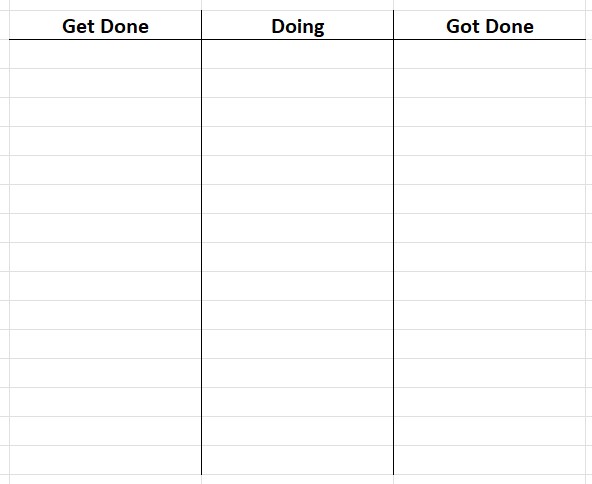
The only other stipulation is that you can physically move each item from one column to another. You should only be writing your get dones once, and then have the ability to move them around.
Some suggestions of how to set up your list include:
- Using a spreadsheet (you type the get dones and then can drag each cell around);
- Using a magnetic whiteboard (you write the get dones on magnet backed things. Be they laminated bits of paper, or small magnetic whiteboards);
- Using a board and post stick / post it notes or paper with blu-tak or drawing pins (cork boards, white boards, spare area of a wall… But the notes then move around).
Ensure your columns survive as you move things around! And also ensure that there is space for all the got dones you are going to achieve!
Using Your Get Done List
Each evening, start by writing down all the things you need / want to get done tomorrow. Then prioritise these activities and put them in the Get Done column in the order of priority.
When you get up the next day, start with number one and move it to the Doing column.
Work on it until it is complete, or as complete as you can get it.
Once complete, move it to the Got Done column.
Then, and only then, do you give attention to the next activity on the list. Move that to Doing and get on with it. Pay no attention to anything else on your list! Focus on one activity at a time. Try not to have too many things in the Doing column at any one time.
Focusing on one at a time allows you to complete that task with your full attention and engagement. This means that it will get done quicker, and to a better standard than if you are flitting between activities or getting distracted.
What Happens If I Get Distracted, Or Can’t Focus?
We are human and we live in a world of distractions! There are ways to minimise these; hiding your phone / silencing notifications. Putting on noise cancelling headphones with wordless music that helps you focus. Choosing a suitable, quiet place to work. Turning off notifications on your computer… But we all get distracted sometimes!
Know that it happens and is perfectly natural. You simply have to refocus when you notice your mind has wondered off. Don’t give yourself a hard time about it! Just notice your mind has wandered off, and either bring it straight back onto the task, or step away for a moment to refresh.
It is good advice to take a short 5-minute break every 25-30minutes whilst working. Getting a drink, using the bathroom, a quick walk, anything that helps to refresh you. Then you get back to the task you were on and keep going!
My Time Mastery course will give you many other things to try when you notice you have been distracted!
How Many Things Do I Put On My Get Done List?
As you use this approach over time, you will learn how many Get Dones you are personally capable of achieving each day, based on the activities you need to do. It can be very tempting to put loads of things on the list! And then get demoralised when you don’t get many done…
This is the to do list approach!
To achieve the best of both worlds, have two Get Done lists.
A master one which has everything you need to get done over the foreseeable future, and a daily one. Then each evening, look at your master list and then choose the highest priority ones to put on your daily list for tomorrow.
Tomorrow, you ignore the master list, it is still there. Nothing will be forgotten from it. Just work from the daily one.
If you get everything done on your daily list, because you were more effective than you thought you would be, then you have your master list from which you can choose another activity from. Or, you have a pre-planned reward for getting everything done! Something that is just for you, that is your pat on the back. This can be a form of motivation to help you stay focused on the things you need to get done.
As I said, the longer you use this approach, the easier it will become to know how many things to put on your daily get done list.
Your list will be longer or shorter than others, and that is OK. We all have different commitments, amounts of time to dedicate to things, rates of work. That is what makes us individual. You work on your own list, at your own pace.
Do not compare your productivity to anyone else but yourself.
Your Got Done List
Every time you move an activity from Doing to Got Done, it is a visual reminder of the achievements and successes you have achieved that day. You have the option of creating a new list every day, or simply clearing the Get Dones and Doing and replacing with tomorrows. Anything left on the Doing list can be moved to tomorrow’s Get Done list.
But the key point is to keep a track of all things that reach the Got Done column! This is now your list of little wins. And little things all add up to big things!
On a spreadsheet you simply never delete this column, or move the list to another sheet. If you are using a physical board, take a picture every time you need to clear the board because it is full and you have run out of space (which will happen!).
By keeping a record of all your Got Dones, you have an instant sense of achievement list that you can look at whenever you feel like you haven’t been productive on any given day.
There will be days when you are not as productive or efficient. But, again, we all have those days! The key on those days is to be kind to yourself. Refocus as often as you need to and get done what you get done. Even a couple of got dones a day still adds to the goal you are striving towards!
Now its time for the last of today’s Principle Of Success.
Principles of Success #7 – Decision
Decision is a skill that we all must learn to live effective lives. We choose to make decisions or we choose to not make them and let someone else make them for us.
The second option puts your life in someone else’s hands and that is not a way to live.
When it comes to making a decision, you can only make it where you are and with what you have. Don’t try to predict what you will have, it won’t work as nothing is guaranteed. Also, making decisions on past experiences is also not the best idea; things have changed since then, you have more information.
Can You Change A Decision Once Made?
If you suffer from hindsight, know that any decision made can be remade when you have more information. Make decisions based on the information you have in that moment, and if it turns out to be the wrong one later on then so be it. It was the best one you could have made in the moment, you can’t change it, so just make a new one and carry on!
The plan can change, the goal does not! Don’t be afraid to change the plan. Criticism is temporary! Be the bigger person, take responsibility when you realise you have made a mistake, make a new decision and move on. There is nothing to be gained in wishing you’d made a different decision or beating yourself up over it.
The following is an article from Bob Proctor that I also recorded myself reading. You can carry on reading or hear me read the article in this video.
Decision By Bob Proctor
There is a single mental move you can make which, in a millisecond, will solve enormous problems for you. It has the potential to improve almost any personal or business situation you will ever encounter … and it could literally propel you down the path to incredible success. We have a name for this magic mental activity … it is called DECISION.
Decisions, or the lack of them, are responsible for the breaking or making of many a career. Individuals who have become very proficient at making decisions, without being influenced by the opinions of others, are the same people whose annual incomes fall into the six and seven figure category. However, it’s not just your income that is affected by decisions; your whole life is dominated by this power. The health of your mind and body, the wellbeing of your family, your social life, the type of relationships you develop … all are dependent upon your ability to make sound decisions.
You would think anything as important as decision making, when it has such far reaching power would be taught in every school, but it is not. To compound the problem, not only is decision-making missing from the curriculum of our educational institutions, up until recently it’s also been absent from most of the corporate training and human resource programs available.
So, how is a person expected to develop this mental ability?
Quite simply, you must do it on your own. However, I think it’s important to understand that it’s not difficult to learn how to make wise decisions. Armed with the proper information and by subjecting yourself to certain disciplines, you can become a very effective decision maker.
You can virtually eliminate conflict and confusion in your life by becoming proficient at making decisions. Decision-making brings order to your mind, and of course, this order is then reflected in your objective world … your results.
James Allen may have been thinking of decisions when he wrote,
“We think in secret and it comes to pass. Environment is but our looking glass.”
James Allen
No one can see you making decisions, but they will almost always see the results of your decisions. The person who fails to develop their ability to make decisions is doomed because indecision sets up internal conflicts which can, without warning, escalate into all out mental and emotional wars. Psychiatrists have a name to describe these internal wars, it is ambivalence. My Oxford Dictionary tells me that ambivalence is the coexistence in one person of opposite feelings toward the same objective.
You do not require a doctorate degree in psychiatry to understand that you are going to have difficulty in your life by permitting your mind to remain in an ambivalent state for any period of time. The person who does permit it to exist will become very despondent and virtually incapable of any type of productive activity. It is obvious that anyone who finds themselves in such a mental state is not living; at best, they are merely existing. A decision or a series of decisions would change everything.
A Basic Law Of The Universe
A very basic law of the universe is “create or disintegrate”. Indecision causes disintegration. How often have you heard a person say, “I don’t know what to do.” How often have you heard yourself say, “What should I do?” Think about some of the indecisive feelings you and virtually everyone on this planet experience from time to time.
LOVE THEM – LEAVE THEM
QUIT – STAY
DO IT – DON’T DO IT
GO BANKRUPT – NO DON’T
GO TO WORK – WATCH TV
BUY IT – DON’T BUY IT
SAY IT – DON’T SAY IT
TELL THEM – DON’T TELL THEM
Everyone, on occasion, has experienced these feelings of ambivalence. If it happens to you frequently, decide right now to stop it. The cause of ambivalence is indecision, but we must keep in mind that the truth is not always in the appearance of things. Indecision is a cause of ambivalence; however it is a secondary cause, it is not the primary cause. I have been studying the behaviour of people who have become very proficient at making decisions for over a quarter century. They all have one thing in common. A very strong self-image, a high degree of self-esteem.
They may be as different as night is too day in numerous other respects, but they certainly possess confidence. Low self-esteem or a lack of confidence is the real culprit here. Decision makers are not afraid of making an error. If and when they make an error in their decision, or fail at something, they have the ability to shrug it off. They learn from the experience, but they will never submit to the failure.
The Cardinal Principle Of Decision Making
Every decision maker was either fortunate enough to have been raised in an environment where decision-making was a part of their upbringing, or they developed the ability themselves at a later date. They are aware of something that everyone, who hopes to live a full life, must understand: Decision-making is something you cannot avoid.
That is the cardinal principle of decision-making. DECIDE RIGHT WHERE YOU ARE WITH WHATEVER YOU’VE GOT. This is precisely why most people never master this important aspect of life. They permit their resources to dictate if and when a decision will or can be made. When John Kennedy asked Werner Von Braun what it would take to build a rocket that would carry a man to the moon and return him safely to earth, his answer was simple and direct. “The will to do it.” President Kennedy never asked if it was possible. He never asked if they could afford it or any one of a thousand other questions, all of which would have … at that time … been valid questions.
President Kennedy made a decision … he said, we will put a man on the moon and return him safely to earth before the end of the decade. The fact that it had never been done before in all the hundreds of thousands of years of human history was not even a consideration. He DECIDED where he was with what he had. The objective was accomplished in his mind the second he made the decision. It was only a matter of time … which is governed by natural law before the goal was manifested in form for the whole world to see.
Just Decide!
I was … just hours ago … in an office with three people. We were discussing the purchase of shares in a company. I was selling, they were buying. After a reasonable amount of time, one of the partners asked me when I wanted a decision. I replied, “Right now.” I said, “You already know what you want to do.” There was some discussion about money. I pointed out that money had nothing to do with it. Once you make the decision you will find the money … every time.
If that is the only benefit you receive from this particular message on decision-making, burn it into your mind. It will change your life. I explained to two of these people that I never let money enter my mind when I am deciding whether I will or will not do something. Whether I can afford it or not is never a consideration. Whether I want to or not is the only consideration. You can afford anything, there is an infinite supply of money. All of the money in the world is available to you, when the decision is firmly made. If you need money, you will attract it.
I am well aware there are any number of people who will say that is absurd. You can’t just decide to do something if you do not have the necessary resources. And that’s fine if that is the way they choose to think. I see that as a very limiting way of thinking. In truth, it probably is not thinking at all … it is very likely an opinion being expressed that was inherited from another older member of their family who did not think either.
Study The Great Thinkers
Thinking is very important. Decision makers are great thinkers. Do you ever give much consideration to your thoughts? … how they affect the various aspects of your life? Although this should be one of our most serious considerations, for many people it is not. There is a very small select few who make any attempt to control or govern their thoughts.
Anyone who has made a study of the great thinkers, the great decision makers, the achievers of history, will know they very rarely agreed on anything when it came to the study of human life. However, there was one point on which they were in complete and unanimous agreement and that was, “We become what we think about.”
What do you think about? You and I must realize that our thoughts ultimately control every decision we make. You are the sum total of your thoughts. By taking charge this very minute, you can guarantee yourself a good day. Refuse to let unhappy, negative people or circumstances affect you.
The greatest stumbling block you will encounter when making important decisions in your life is circumstance. We let circumstance get us off the hook when we should be giving it everything we’ve got. More dreams are shattered, and goals lost because of circumstance than any other single factor.
How often have you caught yourself saying, “I would like to do or have this but I can’t because…” Whatever follows “because” is the circumstance. Circumstances may cause a detour in your life but you should never permit them to stop you from making important decisions.
Napoleon said,
“Circumstances, I make them.”
Napoleon Bonaparte
Don’t Make Excuses, Make Decisions!
The next time you hear someone say they would like to vacation in Paris or purchase a particular automobile but they can’t because they have no money, explain they don’t need the money until they make a decision to go to Paris or purchase the car. When the decision is made, they will figure out a way to get the amount needed. They always do.
Many misguided individuals try something once or twice and if they do not hit the bullseye, they feel they are a failure. Failing does not make anyone a failure, but quitting most certainly does and quitting is a decision. By following that form of reasoning, you would have to say when you make a decision to quit, you make a decision to fail.
Every day in America, you hear about a baseball player signing a contract, which will pay him a few million dollars a year. You should try to keep in mind … that same player misses the ball more often than he hits it when he steps up to the plate.
You Only Need To Succeed Once!
Everyone remembers Babe Ruth for the 714 home runs he hit and they rarely mention that he struck out 1,330 times.
Charles F. Kettering said, and I quote,
“When you’re inventing, if you flunk 999 times and succeed once, you’re in.”
Charles F. Kettering
That is true of just about any activity you can name, but the world will soon forget your failures in light of your achievements. Don’t worry about failing, it will toughen you up and get you ready for your big win. Winning is a decision.
Many years ago Helen Keller was asked if she thought there was anything worse than being blind. She quickly replied that there was something much worse. She said, “The most pathetic person in the world is a person who has their sight but no vision.” I agree with Helen Keller.
At 91, J.C. Penny was asked how his eyesight was. He replied that his sight was failing but his vision had never been better. That is really great, isn’t it?
When a person has no vision of a better way of life, they automatically shut themselves in a prison; they limit themselves to a life without hope. This frequently happens when a person has seriously tried, on a number of occasions, to win, only to meet with failure time after time. Repeated failures can damage a person’s self-image and cause them to lose sight of their potential. They therefore make a decision to give up and resign themselves to their fate.
Take The First Step
Take the first step in predicting your own prosperous future. Build a mental picture of exactly how you would like to live. Make a firm decision to hold on to that vision and positive ways to improve everything will begin to flow into your mind.
Many people get a beautiful vision of how they would like to live but because they cannot see how they are going to make it all happen, they let the vision go. If they knew how they were going to get it or do it, they would have a plan not a vision. There is no inspiration in a plan but there sure is in a vision. When you get the vision, freeze frame it with a decision and don’t worry about how you will do it or where the resources will come from. Charge your decision with enthusiasm … that is important. Refuse to worry about how it will happen.
Advanced Decision Making
We make advanced bookings when we fly somewhere – that is quite common. Make advanced reservations to eliminate any confusion or problems when the time arrives for the journey. We do the same with renting a car, for the same reason. Think of the problems you will eliminate by making many of the decisions you must make … well in advance. I’ll give you an excellent example. As I am preparing this message it is Ramadan, a time where all practicing Muslims fast.
I was in an office yesterday in Kuala Lumpur and was asked if I would like a cup of tea or coffee. I replied that I would appreciate a cup of tea. The lady next to me was then asked if she would like a cup and she replied … “No, I’m fasting.” When she was asked, she did not have to decide whether she wanted anything or not. Whether she was thirsty or not was not a consideration. A decision had previously been made and her advanced Decision was well tempered with discipline.
The exact same concept works with a person when they are on a diet to release weight. Their decisions are made in advance. If they are offered a big slice of chocolate cake, they don’t have to say, “Gee, that looks good … I wonder if I should.” The decision is made in advance.
Don’t Entertain Why Something Can’t Be Done
I made a decision a long time ago that I would not participate in discussions of why something cannot be done. The only compensation you will ever receive for participating in or giving energy to that type of discussion is something you do not want. I always find it amazing at the number of seemingly intelligent people who persist in dragging you into these negative brainstorming sessions. In one breath these people tell you they seriously want to accomplish a particular objective. And, in the next breath, they begin talking about why they can’t. Think of how much more of life they would enjoy by making a decision that they will no longer participate in that type of negative energy.
The humanistic psychologist, Dr. Abraham Maslow who devoted his life to studying self actualized people, stated very clearly that we should follow our inner guide and not be swayed by the opinion of others or outside circumstances. Maslow’s research showed that the decision makers in life had a number of things in common; most importantly, they did work they felt was worthwhile and important. They found work a pleasure, and there was little distinction between work and play. Dr. Maslow said, to be self-actualized you must not only be doing work you consider to be important, you must do it well and enjoy it.
Dr. Maslow recorded that these superior performers had values, those qualities in their personalities they considered to be worthwhile and important. Their values were not imposed by society, parents or other people in their lives. They did make their own decisions. Like their work, they chose and developed their values themselves.
Life Is Short!
Your life is important and, at its best, life is short. You have the potential to do anything you choose, and to do it well. But, you must make decisions and when the time for a decision arrives, you must make your decision where you are with what you’ve got.
Let me leave you with the words of two great decision makers, William James and Thomas Edison. William James suggested that, compared to what we ought to be, we are making use of only a small part of our physical and mental resources. Stating this concept broadly, the human individual thus lives far within his limits. He possesses powers of various sorts, which he habitually fails to use.
Years later, Thomas Edison said, and I quote,
“If we all did the things we are capable of doing, we would literally astound ourselves.”
Thomas Edison
By making a simple decision, the greatest minds of the past are available to you. You can literally learn how to turn your wildest dreams into reality.
Put this valuable information to use and recognise the greatness, which exists within you. You have limitless resources of potential and ability waiting to develop. Start today – there’s never any time better than the present. Be all that you are capable of being.
What Do You Think?
PS. Have you heard about the upcoming Science of Getting Rich Summit? It might be worth you having a look….. Starts 19th June 2024.